

Finding dozens of sluggish flies on your windows every fall? You’re not imagining things, and you’re not alone.
Cluster flies (Pollenia rudis) invade Worcester County homes from September through November, seeking shelter in wall voids, attics, and upper floors. They’re not breeding in your garbage. They’re overwintering in your structure-and what starts as dozens becomes hundreds emerging throughout winter. Each year the problem grows as pheromones mark your home for returning flies.
Be sure to check out our complete guide on Worcester pest control.
PESTalytix treats cluster fly harborage areas and helps you seal entry points for lasting relief. Schedule your free inspection today.
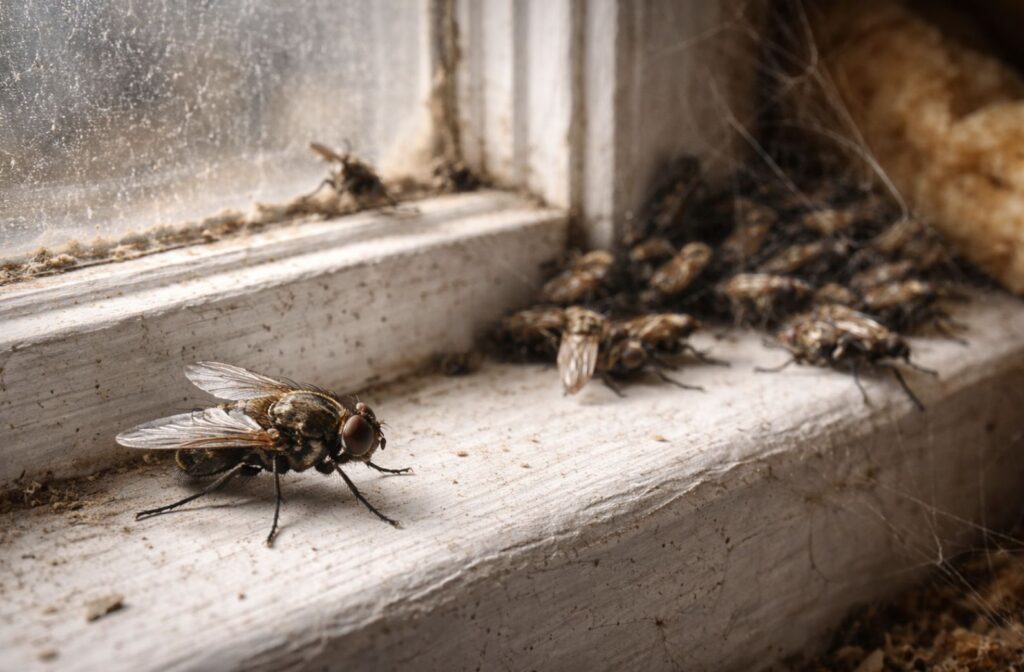
You see large, sluggish flies clustering on sunny windows in fall. More appear on warm January days. They buzz lazily, bump into things, and accumulate on windowsills. These aren’t house flies from your kitchen. They’re cluster flies that entered your home to survive winter.
Why are cluster flies so frustrating?
- They don’t breed inside, so sanitation doesn’t help
- They enter through gaps too small to see
- They hide in wall voids where sprays can’t reach
- Pheromones mark your home, so they return year after year
How Do I Know If I Have Cluster Flies?
Cluster flies look similar to house flies but behave differently. Knowing the difference helps you understand what you’re dealing with.
Cluster Fly vs. House Fly
| Feature | Cluster Fly | House Fly |
|---|---|---|
| Size | Slightly larger, about ⅜ inch | About ¼ inch |
| Color | Dark grey with golden hairs on thorax | Grey with 4 dark stripes on thorax |
| Movement | Sluggish, slow, clumsy | Quick, erratic |
| Season | Fall invasion, winter emergence | Year-round where food exists |
| Source | Outdoors (earthworm parasites) | Garbage, organic matter, filth |
| Location | Windows, attics, wall voids | Kitchens, garbage areas |
| Clustering | Yes, group together for warmth | No, individual behavior |
The Key Difference: House flies breed in garbage and organic matter inside or near your home. Cluster flies spend their summer outdoors, parasitizing earthworms. They enter homes only to overwinter, not to breed.
What You’ll Experience
Fall (September-November):
- Large numbers of flies on sunny exterior walls (south and west facing)
- Flies entering through gaps around windows, doors, eaves
- Clusters forming in attics, wall voids, upper floor rooms
Winter (December-February):
- Flies emerging into living spaces on warm, sunny days
- Dead flies accumulating on windowsills
- Activity in upper floors more than lower floors
Spring (March-April):
- Mass emergence as temperatures rise
- Flies leaving structure to return outdoors
- Activity peaks, then suddenly stops
Severity Assessment: When to Act
| What You’re Experiencing | What It Means | Timeline | Action Needed |
|---|---|---|---|
| Few flies on windows in fall | Small overwintering population | First year | Monitor, seal entry points |
| Dozens of flies appearing daily | Moderate population in walls | Established pattern | Schedule treatment before next fall |
| Hundreds of flies, overwhelming | Heavy infestation, multi-year buildup | Years of entry | Call today |
| Flies in multiple rooms year-round | Severe infestation throughout structure | Extensive | Call today |
Why Do Worcester County Homes Get Cluster Flies?
Cluster flies follow specific environmental patterns. Understanding their lifecycle shows why some properties are targets.
Earthworm Connection: Cluster fly larvae are parasites of earthworms. Properties with healthy lawns, gardens, and moist soil support earthworm populations, which support cluster fly populations. Rural and suburban Worcester County provides ideal habitat.
Why Your House and Not Your Neighbor’s? Cluster flies choose buildings based on warmth, entry points, and past success. If your home has south or west-facing walls, light-colored siding, or complex rooflines (Cape Cods and Colonials are favorites), you’re more attractive to them. Add wooded surroundings with healthy earthworm populations, and you’re in prime cluster fly territory. Once flies successfully overwinter in your structure, pheromones mark it for next year’s population.
Environmental Pressure Factors
| Factor | Why It Attracts Cluster Flies | High-Risk Areas |
|---|---|---|
| Healthy lawns with earthworms | Larval host population | Suburban properties with good soil |
| South/west-facing walls | Warmth attracts aggregation | Any property |
| Light-colored siding | Visible to approaching flies | White, tan, light grey homes |
| Wooded surroundings | More earthworm habitat | Princeton (Mountain Rd), Rutland (Pommogussett Rd), Paxton (Pine Hill Rd) |
| Complex rooflines | More entry points | Cape Cods, Colonials, historic homes |
| Historic homes | More gaps and crevices | Pre-1950 homes along Main St in Sterling, High St in Clinton |
How Are Cluster Flies Getting Into My House?
Cluster flies enter through gaps you can barely see. Understanding where they get in helps you focus prevention efforts.
Housing Type Vulnerabilities
| Housing Era/Type | Common Entry Points | High-Risk Neighborhoods |
|---|---|---|
| Pre-1950 homes | Window frames, attic, balloon framing voids | Sterling Center (Main St, Maple St), Lancaster Center (Rt 70), Clinton (High St historic district) |
| Cape Cods | Dormers, knee wall spaces | Chocksett in Sterling, Jefferson in Holden |
| Colonials | Attic vents, window trim | Holden Center (Highland St), Rutland Center |
| 1970s-1990s homes | Soffit vents, fascia gaps | Suburban Shrewsbury, Hudson |
| Homes near woods | All entry points | Princeton (Wachusett Mountain vicinity), Paxton (Moore State Park area) |
Why Doesn’t Killing the Flies I See Work?
Many homeowners try to address cluster flies by swatting, vacuuming, or spraying those that appear. Here’s why that approach falls short.
You’re Seeing a Fraction of the Population: Cluster flies hide in wall voids, attic insulation, and behind siding. The flies on your windows are emerging from a much larger hidden population. Killing visible flies doesn’t touch the thousands in your walls.
They’re Not Breeding Inside: Unlike house flies, cluster flies don’t reproduce in your home. Every fly you see entered from outside last fall. There are no larvae or eggs to eliminate indoors.
Sprays Don’t Reach Voids: Aerosol sprays kill flies on contact but don’t penetrate wall voids where the main population hides. Foggers deposit product on surfaces but miss concealed spaces.
DIY Cost Reality
Most homeowners spend $65-130 and 10-19 hours on DIY attempts before calling for help. Here’s how it typically plays out:
| Attempt | What You Buy | Cost | Time Spent | Result |
|---|---|---|---|---|
| #1: Swatting/Vacuuming | Nothing | $0 | 5-10 hours over winter | Endless, population not reduced |
| #2: Fly Spray | Aerosol cans | $15-30 | 2-4 hours | Kills visible flies, wall void population unchanged |
| #3: Fogger | Bug bombs | $20-40 | 3-5 hours (including prep) | Surface treatment, voids untouched |
| #4: Window Traps | Sticky traps, light traps | $30-60 | Ongoing | Catches emergers, doesn’t reduce source |
| Total DIY | – | $65-130 | 10-19+ hours | Problem returns next year |
What Happens During Professional Cluster Fly Control?
We follow a targeted approach that addresses flies where they hide. Nothing happens without your approval.
| Phase | Duration | What Happens | You Receive |
|---|---|---|---|
| 1. Inspection | Day 1 (1-2 hrs) | Identify entry points, assess severity, check attic/voids | Findings report + recommendations |
| 2. Planning | Day 1-2 | Develop treatment plan, prioritize entry point sealing | Written plan with pricing |
| 3. Customer Approval | Flexible | Review plan, you approve scope | Clear understanding of approach |
| 4. Treatment | Scheduled (fall optimal) | Apply residual dust to attic, wall voids, harborage areas | Service documentation |
| 5. Entry Point Sealing | Optional add-on | Seal identified gaps around windows, eaves, vents | Prevention for future seasons |
Timing Matters: Fall treatment (September-October) intercepts flies as they enter. This is the optimal window. Winter or spring treatment addresses flies already inside but doesn’t prevent next year’s invasion.
Learn more about our approach: Fall Pest Invaders Program
What Special Considerations Apply to Worcester County Properties?
Rural Properties Near Woods: Homes in Princeton along Mountain Rd, Rutland near Demond Pond and Long Pond, Paxton around Moore State Park, and Hubbardston see heavy cluster fly pressure. More woodland means more earthworms, means more flies. Annual treatment may be needed.
Historic Homes (Pre-1950): Older homes in Sterling Center, Lancaster along Main Street, and Clinton’s High Street historic district have more entry points and wall void access. Original windows, balloon framing, and settlement cracks provide easy entry.
Cape Cod and Colonial Styles: These architectural styles feature dormers, complex rooflines, and large attic spaces that cluster flies favor. Homes in Holden’s Jefferson neighborhood and along Wachusett Street are common targets.
Light-Colored Homes: White, tan, and light grey siding attracts cluster flies on sunny fall days. They congregate on warm walls before finding entry points.
Connection to Other Pests: Heavy cluster fly populations attract spiders into attics and wall voids. Solve the fly problem, and spider activity often decreases.
How Much Does Cluster Fly Control Cost?
Every Worcester County property is different. These factors affect your cost.
Cost Factors (Not Pricing)
| Property Factor | How It Affects Cost | Why It Matters |
|---|---|---|
| Infestation severity | Heavier populations need more product | Population size affects application rate |
| Attic size and accessibility | Larger attics need more treatment time | Primary harborage area |
| Number of entry points | More gaps to seal | Affects prevention work |
| House style | Complex rooflines = more entry points | Cape Cods, Colonials are more complex |
| Timing | Fall treatment is optimal | Winter treatment addresses current flies only |
| Entry point sealing | Optional but recommended | Prevents future invasions |
Your free inspection includes a detailed quote. No surprises. Schedule your inspection today.
How Do I Reduce Cluster Fly Problems?
Professional treatment addresses current populations. These steps prevent future invasions.
Seal Entry Points (Most Important):
- Caulk around all window frames (interior and exterior)
- Repair or replace damaged screens on attic vents
- Seal gaps where dormers meet walls
- Close gaps along fascia and soffit lines
- Caulk around utility penetrations (cable, electrical)
- Replace worn door weatherstripping
Fall Vigilance:
- Watch for fly aggregation on sunny walls in September-October
- Address entry points before flies find their way inside
- Schedule preventive treatment in early fall
Frequently Asked Questions
Are cluster flies dangerous?
No. Cluster flies don’t bite, don’t spread disease, and don’t breed in garbage or filth. They’re annoying because of their numbers and their habit of emerging on warm days, but they’re harmless.
Why do flies appear on warm winter days?
Cluster flies are hibernating in your walls. When wall voids warm up on sunny days, flies become active and move toward light. When it cools down, activity stops.
Can I just wait for spring when they leave?
Yes, cluster flies will leave in spring. But they’ll return next fall. Without treatment or sealing, you’ll have the same problem every year-and it typically gets worse as pheromones attract more flies.
Why is my neighbor’s house fine but mine has cluster flies?
Cluster flies choose structures based on warmth, entry point availability, and pheromone markers. Once flies successfully overwinter in a building, they return annually.
When is the best time to treat?
Early fall (September-October), before or as flies are entering, is optimal. Treatment establishes residual protection in wall voids before populations build.
End the Annual Invasion
Cluster flies return year after year to the same structures. Each fall brings the same pattern: aggregation on sunny walls, entry through gaps, months of emergence. You don’t have to live with it.
PESTalytix serves homeowners across Worcester County. From historic homes in Sterling Center and Lancaster to Cape Cods in Holden’s Jefferson neighborhood, from rural properties near Wachusett Mountain in Princeton to colonial homes along Highland Street, we treat cluster fly harborage and help you seal entry points for lasting relief. Our inspection is free. Our recommendations are honest. Break the cycle this fall.