
Worcester County’s 60 towns face year-round rodent pressure from house mice (Mus musculus) and Norway rats (Rattus norvegicus). Traditional pest control schedules react to what you see. Digital monitoring predicts what’s developing by tracking behavior patterns around the clock. As part of our comprehensive Worcester County pest control services, PESTalytix combines continuous sensor data with professional service to catch problems early, before rodent populations establish or auditors find issues.
Whether you manage Worcester Triple-Deckers along Main South’s Green Street, Sterling Center homes with pre-1900 fieldstone foundations on Main Street (Route 12), or Shrewsbury Route 9 corridor restaurants near Lake Quinsigamond (6 miles long), digital monitoring adapts through location-specific baselines.
Digital pest monitoring changes how we detect and respond to rodent activity. Instead of relying on monthly visual inspections or tenant complaints, sensors track rodent interactions with monitoring stations continuously. Every location learns what’s normal for itself. When patterns shift, the system alerts us to act.
We support both residential and commercial pest monitoring needs
How Digital Pest Monitoring Works
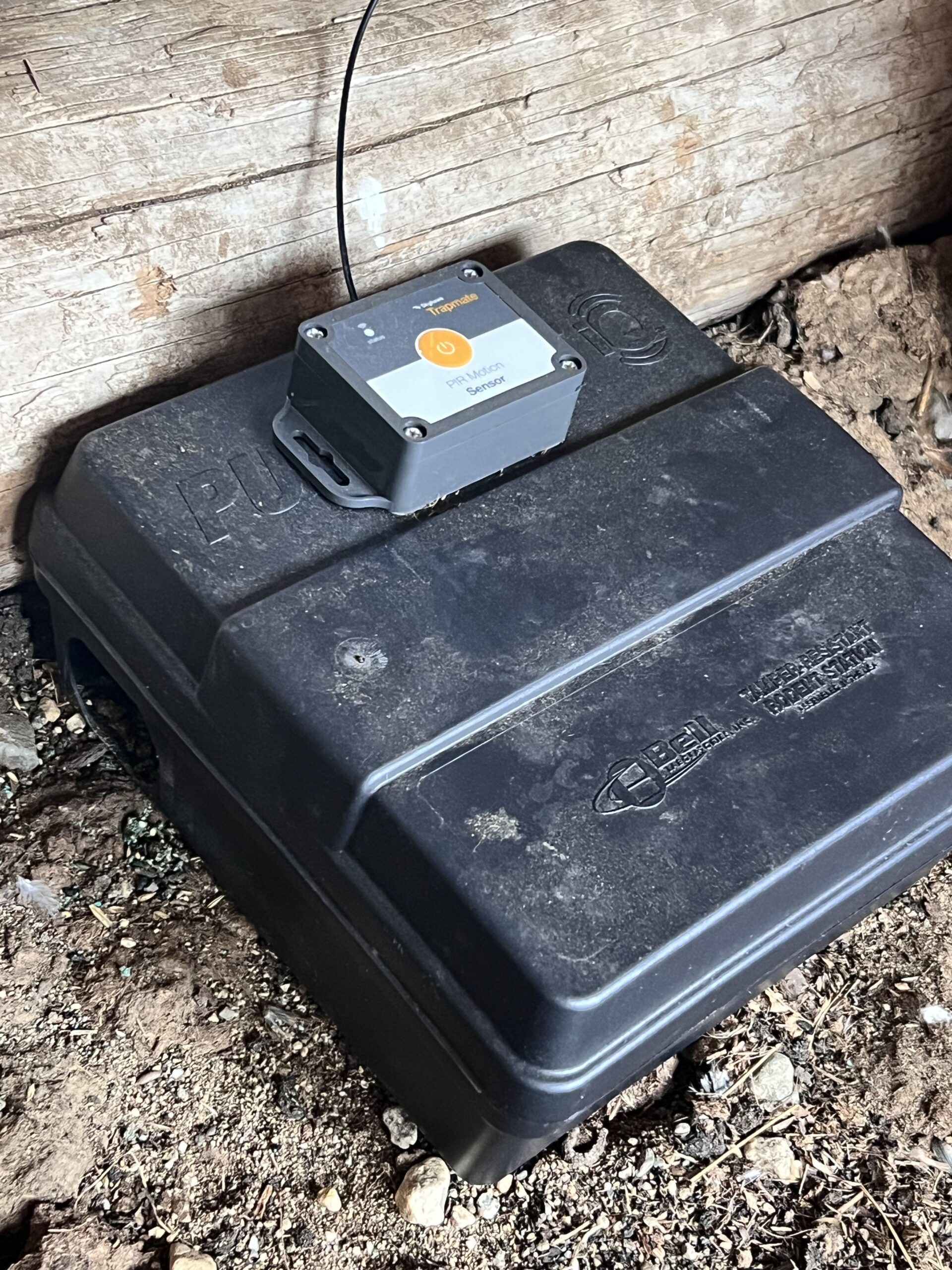
Digital monitoring pairs hardware sensors with software that analyzes patterns. Neither works alone. Sensors detect rodent activity at monitoring stations. Software studies patterns over time to determine when we need to step in.
What Makes the System Send an Alert?
Every monitoring station gets checked daily using five separate behavior signals:
- Signal 1: Extreme Activity Spikes – Days when activity jumps way outside normal range (Example: 15 interactions when baseline is 0-2 per day)
- Signal 2: Abnormal Behavior Changes – Uses statistics to detect shifts from typical patterns (Example: Consistent 4-5 interactions daily when baseline is 0-1)
- Signal 3: Steady Pressure Increase – Tracks whether pressure climbs or bounces randomly (Example: October averages 8 interactions versus June’s average of 2)
- Signal 4: Faster Return Visits – Monitors how quickly rodents return between visits (Example: Mice returning every 6 hours versus previous 48-hour pattern)
- Signal 5: Confirmed Physical Events – Captures definite activity like trap captures (Example: Electronic trap confirms rodent caught)
No single number determines action. The system looks at all five signals together. A location might need attention even if no single measure is extreme. The overall pattern shows rising pressure. Read the complete five-signal methodology whitepaper for technical details.
How Does It Know What’s Normal for My Property?
Generic monitoring systems use the same thresholds everywhere. Our platform learns what’s normal for each specific spot. Your Sterling Chocksett neighborhood basement behaves differently than a Worcester Tatnuck Square attic. An outside station near bushes might show routine background activity. An inside pantry station should show zero sustained activity.
When we install a new station, the system collects data for several weeks before setting expectations. During this learning time, alerts stay conservative to avoid reacting to one-time events. Once baseline behavior is set, the system adapts continuously.
This eliminates the question “Is this normal?” The system knows what normal looks like for that exact location. Changes become obvious immediately.
Why Doesn’t It Alert for Every Mouse That Walks By?
Rodent presence is a single event. Rodent pressure is a pattern. A mouse walking past an outside sensor once doesn’t signal a problem. The same mouse visiting daily, then twice daily, then three times daily shows escalating pressure. For detailed information on mouse behavior and entry patterns, see our complete guide to controlling mice.
Traditional service waits for visible proof. By the time technicians see droppings or property managers get tenant complaints, populations may already be established. Digital monitoring catches behavior patterns weeks earlier.
| Single Event | Pressure Pattern |
|---|---|
| Mouse walks past sensor | Mice visit sensor daily with increasing frequency |
| Trap catches one mouse | Traps trigger repeatedly with faster return times |
| Visual inspection finds nothing | Data shows steady escalation over 3 weeks |
| Tenant reports hearing scratching | System detected acceleration 2 weeks earlier |
| Auditor finds no activity during visit | Historical data proves continuous monitoring |
How Is Digital Monitoring Different from Regular Service?
Traditional pest control and digital monitoring represent different approaches. Neither replaces the other. Digital monitoring enhances our expertise if a company is able to derive insights from monitoring.
| Traditional Approach | Digital Monitoring Approach |
|---|---|
| Fixed monthly or quarterly visits | Response based on actual activity patterns |
| Visual inspection during scheduled visits | Continuous monitoring between visits |
| Reacts to visible signs like droppings or damage | Predicts pressure before visible signs appear |
| Relies on tenant complaints or property checks | Alerts arrive before occupants notice problems |
| “Did we catch anything this month?” | “Is pressure increasing compared to last month?” |
| Documentation shows visit dates | Data shows activity trends and what triggered action |
| Technician finds problems during inspection | System detects changes as they develop |
| Schedule-driven service | Data-driven service |
When Does Traditional Service Work Best?
Fixed service schedules make sense for stable, low-risk settings. Properties with consistent pest pressure benefit from regular preventive treatments. Visual inspections by experienced technicians spot entry points and environmental factors no sensor can detect.
Many properties run successfully with monthly or quarterly traditional service. Technicians provide expertise in structural assessment, exclusion recommendations, and treatment application.
When Does Digital Monitoring Add Value?
Digital monitoring excels at detection speed, documentation depth, and accurate prioritization. Properties with hard-to-access monitoring locations benefit from immediate notifications. High-stakes environments benefit from early warning systems.
Examples from Worcester County:
- Sterling lakefront properties (East Waushacum Pond, Sholan Park area) with seasonal vacation homes
- Worcester Main South multi-family buildings along Belmont Street and Lincoln Street
- Shrewsbury Bay State Commons office parks near Route 9 and Hartford Turnpike
- Clinton Water Street industrial facilities near I-190 interchange
The Combined Approach
Most PESTalytix digital monitoring setups combine both methods. Sensors provide continuous detection and trend analysis. Technicians provide structural assessment, exclusion work, and treatment application. Digital data tells technicians where to focus effort. This combination addresses the basic limitation of either approach alone.
How Do Smart Rodent Sensors Actually Work?
Smart monitoring hardware consists of sensors placed at critical monitoring stations throughout a property. These devices detect rodent interactions. Activity at bait stations, movement past sensors, or captures in electronic traps all register. Data transmits wirelessly to the monitoring platform.
Why Do Basement Sensors Work Differently Than Outdoor Ones?
Not all locations carry the same risk. Inside and outside stations serve different purposes and use different alert settings.
Inside Locations: Very Low Tolerance for Any Ongoing Activity
Inside monitoring stations should show minimal to zero sustained rodent activity. Any persistent pattern means elevated risk because rodents have already gotten inside.
Worcester County examples:
- Sterling Center historic homes (Main Street/Maple Street intersection area) with fieldstone foundation gaps from 1880s-1920s construction
- Worcester Triple-Decker shared wall voids in Vernon Hill and Main South neighborhoods
- Shrewsbury restaurant dry storage rooms along Route 9 (Shops at Brickyard area)
- Holden commercial kitchen grease trap areas near Wachusett Street and Main Street intersection
Outside Locations: Focus on Stopping Inward Movement
Outside monitoring stations may show routine background activity from passing rodents. Not every outside interaction requires action. Action triggers when patterns show escalation toward the building.
Worcester County examples:
- Lancaster farm property boundaries near Route 70 agricultural fields and Sawyer Hill orchards
- Worcester Canal District loading dock edges along Commercial Street and Green Street
- Clinton Water Street industrial park buildings near Pratts Junction
- Sterling properties bordering Wachusett Reservoir (5,200 acres) conservation land along Route 140
Will These Work in My Old House? (Connectivity Questions)
Worcester County properties face varying connectivity challenges. The county’s mix of dense urban (Worcester’s 206,000+ residents), suburban commercial corridors (Shrewsbury Route 9, Westborough Route 9), and rural conservation land (Sterling, Princeton, Harvard) creates different technical needs.
| Connectivity Type | Best For | Limitations | Worcester County Performance |
|---|---|---|---|
| WiFi | Newer construction with wireless infrastructure | Range limits through thick walls | Excellent in Shrewsbury Route 9 corridor and Westborough office parks. Struggles in Sterling Center historic district fieldstone basements and Lancaster pre-1900 farmhouses. |
| Cellular | Remote locations, avoids WiFi sharing | Requires cellular signal | Strong along I-290, Route 9, I-190 corridors. Good in Worcester, Shrewsbury, Holden urban areas. May face challenges in rural basements (Princeton, Hubbardston, Rutland). |
| LoRaWAN | Large facilities, IoT-optimized | Needs gateway infrastructure | Ideal for Worcester industrial complexes near Green Street and Commercial Street, Clinton Water Street facilities, Leominster North Street industrial areas. |
Most installations use cellular connectivity for reliability. Residential customers appreciate not sharing home WiFi passwords. Commercial facilities avoid IT department coordination.
Do I Have to Change Batteries Every Week?
Sensor batteries typically last 1-3 years depending on device type and activity levels. The platform monitors battery status and alerts before they run out. Technicians replace batteries during regular service visits.
No sensor installation is “set and forget.” Hardware requires periodic maintenance. Digital monitoring adds to human expertise. It doesn’t eliminate the need for professional service.
Do These Things Actually Work or Is It Just Marketing?
The most common concern about digital monitoring is reliability. Will sensors detect activity? Will alerts actually arrive? Will false alarms overwhelm users?
The five-signal method addresses these concerns. By checking multiple behavior patterns simultaneously and comparing each station to its own baseline, the system minimizes false positives while keeping high sensitivity to real threats.
False alarms typically result from:
- Environmental triggers (temperature swings, vibration)
- Non-target animals (insects, improperly placed sensors)
- Installation errors (sensors too sensitive, poorly positioned)
Baseline learning during the first several weeks helps tell routine environmental factors from actual rodent activity. Stations showing frequent false triggers get adjusted sensitivity or repositioning.
Users see exactly what triggered each alert. Not “something happened” but “activity exceeded extreme threshold” or “return visits accelerated beyond baseline behavior.” This clarity builds confidence that alerts reflect real risk.
What Does the Monitoring Software Do?
Smart sensors are only half of digital monitoring. Software turns raw activity data into useful insights.
Digital Logbooks and Compliance Documentation
Paper logbooks have multiple limits for facilities needing documentation. Handwritten entries lack timestamps proving when inspections happened. Historical trend analysis requires manual data gathering. Auditors question whether logs accurately reflect service frequency.
Digital logbook systems create automatic timestamped records every time we inspect or service a station. QR codes at each station let technicians scan and document findings instantly. Data goes directly into the monitoring platform.
For Worcester County food processing facilities, pharmaceutical operations, and institutional kitchens, this creates audit-ready documentation proving:
- Monitoring station locations and numbering
- Service visit dates and times
- Findings at each station during each visit
- Actions taken responding to activity
- Trends over time showing program effectiveness
Trend Analysis and Risk Scoring
Individual station data means little without context. Has activity increased compared to last month? Which locations show rising pressure? Where should technicians focus?
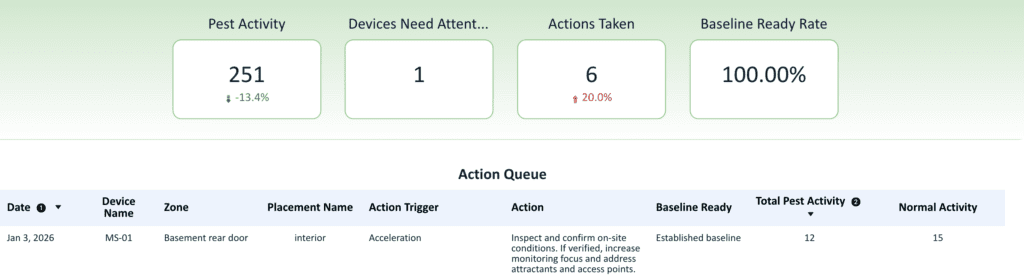
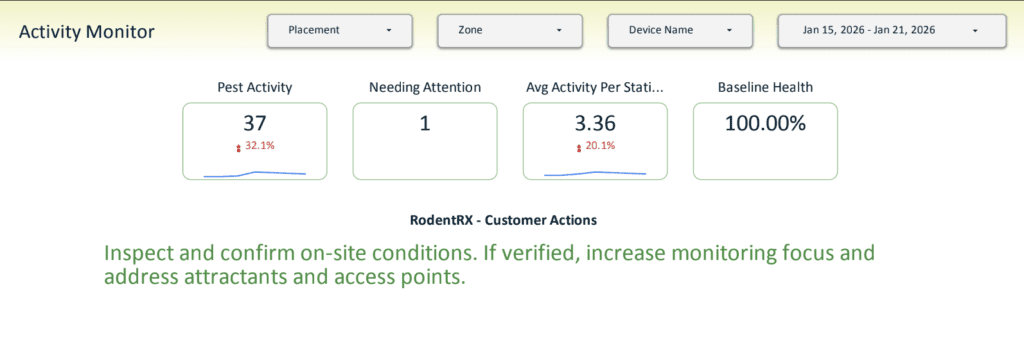
The platform gives each monitoring spot a daily risk score based on all five signals combined. This allows service prioritization based on data rather than fixed schedules.
Example: A Worcester Main South multi-family property on Belmont Street has 30 monitoring stations. Traditional service inspects all 30 monthly regardless of activity. Digital monitoring shows 3 stations with elevated risk scores, 5 with moderate scores, and 22 with low scores. Technicians focus effort on the 8 locations showing pressure.
Risk scores also identify locations trending toward problems. A station currently showing low activity but demonstrating steady escalation over recent weeks gets attention before risk becomes high. This preventive focus represents the core value of continuous monitoring.
Real-Time Reporting and Communication
Property managers, facility directors, and compliance officers need visibility into pest control program performance. Digital platforms provide customizable reporting showing:
- Current activity levels across all monitoring locations
- Trend graphs comparing recent months to historical averages
- Action logs showing interventions and outcomes
- Station map views highlighting risk distribution
For residential customers, simplified dashboards show property status at a glance. Green indicators show stations with no concerning activity. Yellow indicators show locations being watched for emerging patterns. Red indicators show stations needing immediate attention.
This transparency eliminates uncertainty. Instead of “The technician said everything looks fine,” customers see exact data showing why that assessment is accurate.
Download a sample RodentRX report
Massachusetts Regulatory Compliance
Massachusetts pest control regulations require service documentation for commercial accounts. Digital systems generate reports meeting these requirements while providing additional detail.
DCR watershed restrictions near Wachusett Reservoir (5,200 acres) affect Sterling, West Boylston, Boylston, and portions of other Worcester County towns. Digital documentation proves monitoring station locations respect buffer zone requirements. Treatment records show approved materials only.
For food safety facilities operating under FSMA, SQF, or BRC standards, digital trend analysis provides the “risk-based” monitoring documentation these frameworks require. Showing activity trends and intervention triggers demonstrates program effectiveness more convincingly than inspection frequency alone.
Is Digital Monitoring Right for Your Property?
Digital monitoring adds value in specific situations. Not every property benefits equally. The decision depends on access challenges, consequence levels, compliance requirements, and pressure patterns.
| Property Characteristic | Digital Monitoring Value | Worcester County Examples |
|---|---|---|
| Hard-to-access locations (attics, crawlspaces, suspended ceilings) | Immediate notification when traps activate | Sterling lakefront vacation homes near Sholan Park, Worcester Triple-Decker third-floor units |
| High-consequence environments (food processing, healthcare, data centers) | Early intervention before populations establish | Clinton Water Street food processing, Worcester UMass Memorial facilities |
| Audit-driven facilities (food safety, pharmaceutical, institutional) | Defensible documentation of monitoring frequency and action thresholds | Shrewsbury biotech facilities on Research Drive, Marlborough pharmaceutical operations |
| Recurring pressure properties (near farms, conservation land) | Tracks whether pressure is stable, seasonal, or escalating | Sterling properties near Wachusett Reservoir, Lancaster farms along Route 70, Harvard near Bare Hill Pond (620 acres) |
| Multi-unit properties (apartments, mixed-use, commercial complexes) | Prioritizes which units or buildings need immediate attention | Worcester Main South buildings, Clinton multi-family on High Street |
When Traditional Service Remains Sufficient
Properties with easy access, low consequence risk, minimal compliance requirements, and infrequent pest pressure may not benefit from digital monitoring’s added complexity and investment.
Single-family homes with routine preventive service, small commercial properties with monthly tech visits, and properties showing no historical pest issues typically continue successfully with traditional approaches.
Technical Requirements
Digital monitoring installation requires connectivity at sensor locations. Worcester County’s mixed geography creates varying technical considerations.
Urban Worcester properties (Main South, Tatnuck Square, Greendale neighborhoods) typically have excellent cellular coverage. Rural Harvard, Princeton, or Hubbardston properties may face connectivity challenges requiring site surveys first.
Thick fieldstone foundations in Sterling Center historic district (Main Street/Maple Street area) or Lancaster pre-1900 homes may block WiFi signals requiring alternative connectivity. Commercial freezers or walk-in coolers need sensors rated for temperature extremes.
Technical feasibility assessment is part of our consultation process. We evaluate connectivity, determine optimal sensor placement, and confirm infrastructure requirements before installation.
Request a free technical assessment for your property
What Are People Worried About with Digital Monitoring?
Will I Get False Alarms?
The baseline learning period specifically prevents false alarms. During initial installation, sensors collect data for several weeks establishing what’s normal for each location. The system learns to distinguish routine environmental factors from actual rodent patterns.
Once baseline behavior is established, alerts reflect genuine behavior pattern changes, not every random event. Users see exactly what triggered each alert. This transparency allows evaluation of whether alerts warrant immediate response.
How Do I Know If It’s Actually Working?
Monitoring platform dashboards show last communication from each sensor. If a sensor stops transmitting data, the platform alerts that the device may have failed or lost connectivity.
Battery status appears in the platform. Low battery alerts arrive weeks before they run out, allowing replacement during scheduled service visits.
The clear method shows exactly which thresholds triggered actions. Learn about our transparent five-signal methodology to see how we explain every alert.
What If the Internet Goes Down?
Battery-powered sensors with onboard memory store activity data locally when connectivity is interrupted. Once connection restores, stored data uploads to the platform. Users see complete activity history including the period when internet was unavailable.
For critical facilities requiring continuous monitoring, cellular-connected sensors provide backup connectivity independent of property internet.
Is My Data Private and Secure?
Monitoring platforms use encrypted data transmission and secure cloud storage. Activity data belongs to the property owner, not the service provider, hardware manufacturer, or software platform.
Sensor hardware does not include cameras or microphones. Devices detect presence and interaction with monitoring stations, not conversations, images, or personally identifiable information.
For facilities with strict data security requirements, platform security documentation and compliance certifications are available for IT department review.
Does This Replace My Pest Control Service?
Digital monitoring enhances professional service. It doesn’t eliminate it. Sensors detect activity patterns. Technicians identify entry points, implement exclusion work, apply treatments, and modify environmental conditions attracting pests.
No sensor can seal foundation gaps, install door sweeps, or remove harborage conditions. These structural solutions require human expertise.
Digital monitoring optimizes when and where technicians focus effort. Instead of inspecting 30 stations monthly hoping to find activity, technicians prioritize the 5 stations showing concerning patterns.
What About Privacy Concerns?
Residential customers sometimes worry about surveillance implications. Monitoring sensors detect rodent activity, not household activities. Devices have no cameras, microphones, or capability to monitor people.
For commercial facilities, employees occasionally question whether monitoring devices track their movements. Sensors mounted near loading docks or storage areas detect rodent activity at bait stations, not employee behavior.
We show customers and facility managers exactly what data sensors collect and how the platform analyzes it.
How Does PESTalytix Use Digital Monitoring?
PESTalytix digital monitoring combines continuous sensor data with professional service. We don’t just install smart traps and send you alerts. We’ve developed a method determining when intervention is necessary before rodents become problems.
Why Our Approach Differs
Some digital monitoring services install sensors and expect customers to interpret data themselves. Others send alerts for every sensor trigger without distinguishing routine activity from genuine threats.
Our five-signal method analyzes multiple behavior patterns simultaneously. Every monitoring station establishes its own baseline. Alerts trigger when patterns show genuine escalation, not isolated events.
This represents three critical differences:
- Proactive, not reactive – Intervention occurs when behavior patterns change, before populations establish
- Site-specific, not generic – Each station is compared to itself, not arbitrary universal standards
- Transparent, not a black box – Every alert shows exactly which thresholds were crossed and why action is recommended
Installation and Setup
Digital monitoring installation begins with property assessment. We identify optimal sensor placement based on historical pest activity locations, structural vulnerabilities, high-risk zones, and property layout.
Sensors get installed, calibrated, and tested. Initial baseline learning period begins, typically 2-4 weeks depending on property type. During this phase, alerts stay conservative while the system learns what’s normal for each location.
Once baselines establish, full monitoring begins. The platform evaluates stations daily using the five-signal method. Users receive alerts when thresholds trigger.
Ongoing Support and Service Integration
Digital monitoring requires ongoing support beyond initial installation. Technicians visit properties for sensor maintenance and battery replacement, calibration verification, response to activity alerts, regular property inspections, and structural assessment.
Support includes platform training, data interpretation assistance, and system optimization as property conditions evolve. Customers aren’t expected to become data analysts.
Measurable Outcomes
Digital monitoring success is measured through detection speed, documentation quality, intervention efficiency, prevention rate, and pressure trends.
These outcomes vary by property type and pest pressure. A Worcester Triple-Decker with recurring mouse issues measures success differently than a Sterling single-family home with seasonal prevention needs.
We establish outcome expectations during consultation based on property characteristics and historical context. Digital monitoring is enhanced detection and data-driven decision-making applied to pest management.
What Affects Digital Monitoring Costs?
Digital monitoring involves hardware investment, software platform access, installation labor, and ongoing service. Multiple factors affect total investment.
Important: The following table explains cost factors, NOT PESTalytix pricing. Final costs depend on property-specific requirements and service scope.
| Cost Factor | What Affects Investment |
|---|---|
| Number of monitoring locations | Properties with multiple buildings, extensive square footage, or numerous high-risk areas require more sensors |
| Hardware type | Basic activity sensors cost less than electronic traps with capture confirmation. Cellular devices cost more than WiFi-only. |
| Connectivity infrastructure | Properties without existing WiFi may require cellular sensors (higher hardware cost) or gateway installation for LoRaWAN |
| Installation complexity | Attic installations, suspended ceiling access, or locations requiring lifts increase labor time |
| Platform subscription | Software access for data analysis, reporting, and alerts typically billed monthly or annually |
| Service integration level | Monitoring-only (customer responds to alerts) costs less than full-service (we respond to all alerts) |
| Property accessibility | Remote properties or facilities requiring escort or security clearance increase service visit costs |
| Baseline establishment needs | Properties with no historical data may require longer baseline periods or additional sensors to establish patterns |
| Compliance documentation requirements | Facilities needing custom reporting for specific audit frameworks may require platform customization |
Hardware vs. Subscription Model Considerations
Digital monitoring costs split between upfront hardware investment and ongoing platform subscription fees. Some providers offer hardware rental programs spreading costs over time. Others require hardware purchase with lower monthly fees.
Neither model is inherently better. Property owners planning long-term monitoring benefit from purchasing hardware, which has lower total cost over 3+ years. Properties wanting flexibility benefit from rental or subscription models with lower upfront commitment.
Integration with Existing Service Programs
Digital monitoring can operate as standalone service or integrate with existing pest control programs. Standalone monitoring costs less initially but transfers responsibility for alert response to property owners.
Integrated service costs more but provides complete coverage. We install sensors, monitor data, and respond to alerts with appropriate interventions.
Most Worcester County customers choose integrated service. Sensors provide detection. We provide expertise and solutions. This combination delivers maximum value from digital monitoring investment.
Frequently Asked Questions
Do electronic mouse traps work for rats?
Electronic traps designed for mice (Mus musculus) typically lack the size and power for Norway rats (Rattus norvegicus). Rat-specific electronic traps exist but cost significantly more. Digital monitoring focuses primarily on detection through sensors, not necessarily electronic trap captures. For properties with mixed mouse and rat pressure, monitoring systems use appropriately sized traps at each station based on target species. Worcester County properties near agricultural areas like Lancaster Route 70 farms, Sterling conservation land borders, and Harvard Bare Hill Pond area may face both species depending on season and food availability.
Is there a mouse trap that sends text messages?
Yes. Multiple manufacturers produce traps with wireless connectivity sending alerts when triggered. However, individual smart traps differ from comprehensive digital monitoring platforms. A single smart trap alerts you it caught something. A monitoring platform analyzes patterns across multiple locations, establishes baselines, and predicts pressure changes before populations establish. PESTalytix digital monitoring includes alert capabilities like text, email, and platform notifications as part of the comprehensive system, not just capture alerts but pattern analysis and risk prioritization.
Do smart traps require subscriptions?
Hardware requirements vary by manufacturer. Some electronic traps operate standalone with no subscription. Others require paid platform access for remote notifications and data storage. Full digital monitoring systems typically include subscription fees covering cloud storage, data analysis, reporting capabilities, and platform support. Standalone smart traps cost less initially but provide minimal data analysis. Subscription-based platforms cost more but deliver the behavior pattern analysis and risk scoring that make digital monitoring valuable beyond simple capture alerts.
Is electronic pest control safe for dogs and cats?
Electronic monitoring sensors and traps pose minimal pet risk when properly installed. Devices mount in areas pets cannot access like wall voids, suspended ceilings, and locked stations. Electronic traps use standard snap mechanisms, not chemicals or poisons. Pets occasionally trigger exterior sensors placed at ground level. This appears as activity data but causes no harm. Interior sensors mounted above pet height eliminate this issue. During installation, we evaluate pet access and position devices accordingly.
Does digital monitoring meet BRC audit requirements?
BRC (Brand Reputation through Compliance) Global Standards require documented pest monitoring with trend analysis. Digital platforms generate the timestamped service records, activity trend reports, and action threshold documentation BRC auditors expect. The clear five-signal method provides defensible reasoning for why interventions occurred when they did. Worcester County food processing facilities in Clinton Water Street area, Worcester Commercial Street facilities, and Leominster North Street operations benefit from this documentation level. Audit findings decrease when pest monitoring programs demonstrate proactive, data-driven decision-making rather than reactive response.
What’s the return on investment for digital monitoring?
ROI calculation depends on what costs digital monitoring prevents. Emergency service calls cost $150-400 each. Audit failures cost thousands in corrective actions and reputation damage. Product contamination costs can reach millions for food facilities. For residential properties, ROI centers on peace of mind value and property protection. Knowing your Sterling lakefront vacation home is monitored while unoccupied, or getting immediate notification if attic trap activity spikes, provides value difficult to measure financially. For commercial facilities, ROI typically measures within 12-24 months through reduced emergency calls, improved audit outcomes, and optimized service efficiency. A Worcester restaurant on Shrewsbury Street spending $800 monthly on reactive pest control may reduce costs to $500 monthly with predictive digital monitoring while achieving better outcomes.
Conclusion
Digital pest monitoring transforms rodent management from reactive response to predictive prevention. Worcester County properties gain continuous oversight whether facing Sterling’s Wachusett Reservoir conservation interface, Worcester’s Main South multi-unit density, or Shrewsbury’s Route 9 commercial compliance requirements.
The five-signal action threshold method provides transparency traditional service cannot match. Every alert is clear. Every intervention is defensible. Both homeowners seeking peace of mind and facility managers needing audit documentation benefit from the same data-driven insights.
Digital monitoring enhances human expertise rather than replacing it. Sensors provide around-the-clock detection between service visits. Technicians provide structural assessment, exclusion work, and treatment solutions no sensor can deliver. This combination represents the future of professional pest management.
Worcester County’s diverse property types, from Sterling Center pre-1900 fieldstone foundations to modern Shrewsbury office parks to Lancaster agricultural interfaces to Worcester institutional facilities, each benefit differently from digital monitoring. The technology adapts through site-specific baselines and risk-appropriate thresholds rather than imposing universal standards.
Whether you’re tired of manually checking attic traps, need audit-ready compliance documentation, or want earlier intervention before rodent populations establish, digital monitoring provides measurable value. The investment reflects enhanced detection speed, documentation quality, and service optimization.