
Eliminate Ant Colonies at the Source.
We identify the species, target the colony, and stop them from coming back.
If you’re in Worcester, Sterling, or Shrewsbury and you’re seeing ant trails in your kitchen, bathroom, or along your foundation, killing the ones you see won’t solve it. The colony is hidden, and the queen keeps producing. We’ll identify what species you have (carpenter ants need very different treatment than pavement ants) and target the actual nest.
Quick request. We’ll confirm what’s going on and give you clear options.
We see the same problem areas again and again in central mass housing.
Foundations Gaps
Ants follow moisture. Foundation gaps in older Worcester County homes (especially fieldstone) provide both entry points and ideal nesting conditions. Carpenter ants particularly love moist wood near foundation contact points.
Weather Striping
Gaps around windows and doors are ant highways. Even small cracks in caulking or weatherstripping give pavement ants easy access. Carpenter ants nest in damp window sills and rotted door frames.
Siding & Utility
Anywhere utilities enter your home creates a gap. Electrical lines, cable boxes, dryer vents, and AC lines all provide entry routes. Ants follow these paths straight into your walls.
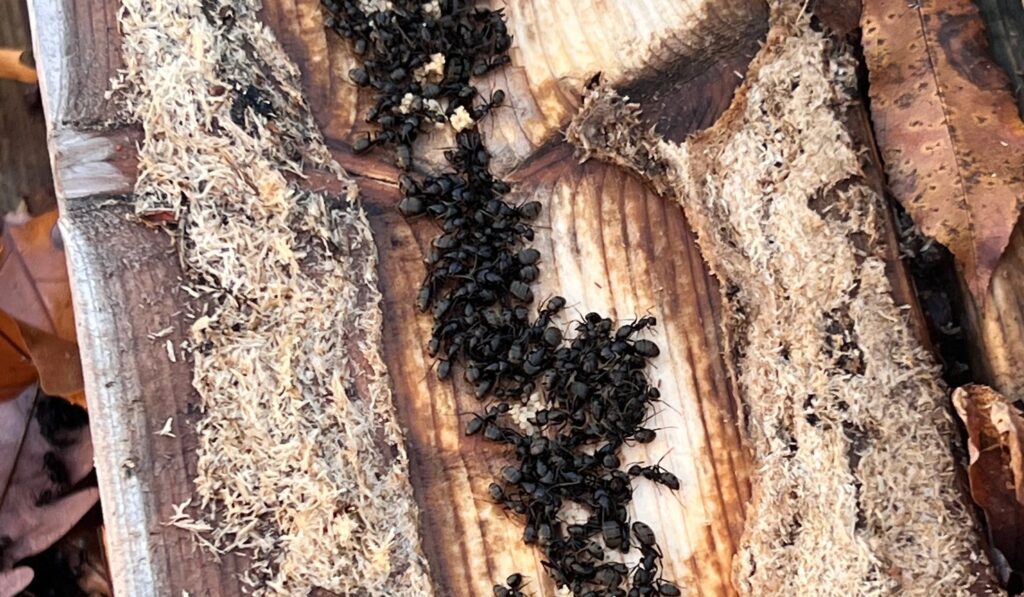
Local Photos of Ants
Quick Gut Check
What are you noticing right now?
What You’re Noticing:
- Small black ants near your kitchen sink or counters
- Trails along baseboards or windowsills
- A few ants appearing after rain
What This Usually Means: You’re seeing foragers from a colony that’s likely outside. Pavement ants and odorous house ants send scouts looking for food and water. The colony might be in your foundation, under your driveway, or in mulch beds.
What You’re Noticing:
- Big ants (1/2 inch long) that look like “giant ants”
- Mostly in bathrooms, near windows, or around wood trim
- Sometimes seeing them in late afternoon or evening
- Finding sawdust-like material (frass) near baseboards
What This Usually Means: You have carpenter ants. They’re not eating your wood (that’s termites), but they’re excavating it to build nests. They prefer moist, soft, or already-damaged wood. If you’re seeing them inside, there’s likely a satellite colony in your walls, attic, or near a moisture problem.
Pick the approach that fits your home and budget.
Most homeowners choose Total Protection because it stops the repeat problem.
Ant Colony Elimination
Starting Price $175
We treat the current mice, but we don’t seal up the outside entry points.
Add-Ons: Yard + Borate Treatments
Price: +$75-150
Yard Treatment: If colonies are in mulch beds, under pavers, or you see many ant nests in your yard.
What It Includes: Granular bait around foundation perimeter, nest treatment in landscaping, moisture barrier recommendations
Borate Treatment: If colonies are in your shed or other wood structure.
What It Includes: Borate liquid application to your wood structures which protects against wood destroying insects
Testimonials
Real Central Mass SituationsSee what your neighbors are saying about us
FAQ
Quick answers to the most popular ant questions.Q: How much does ant extermination cost?
Most Worcester County homeowners pay $175-375 depending on home size, ant species, and severity. Carpenter ants typically cost more ($250-450) because they require moisture investigation and specialized treatment.
What affects the price:
Home size: 1,200 sq ft home costs less than 3,000 sq ft
Ant species: Carpenter ants need thermal imaging and moisture investigation
Colony count: Multiple colonies need separate treatment
Accessibility: Crawl space or attic access adds time
We provide transparent pricing during the inspection so there are no surprises.
Q: What is the best way to get rid of ants?
Kill the queen and destroy the colony. Spraying the trails you see just kills workers. The queen keeps producing more.
Here’s what actually works:
Identify the species first. Carpenter ants, pavement ants, pharaoh ants, and odorous house ants need different treatments. Wrong treatment can make pharaoh ants split into multiple colonies.
Use targeted gel bait. Workers carry it back to the colony and feed it to the queen. This eliminates the entire nest, not just the ants you see.
Find the nest. We use thermal imaging to locate hidden carpenter ant colonies in walls or moisture-damaged wood. You can’t treat what you can’t find.
Fix moisture problems. Carpenter ants are attracted to moist wood. If you don’t fix the leak or drainage issue, they’ll return even after treatment.
Timeline: Trails disappear in 5-7 days as the colony dies. Carpenter ants take 7-14 days for complete elimination.
Q: Why do ants keep coming back after treatment?
Three common reasons:
The treatment only killed visible ants, not the colony. Most DIY sprays and some professional treatments just kill the ants you can see. The queen survives underground or in walls and keeps producing. Gel baits that target the colony work better than contact sprays.
You have carpenter ants and the moisture problem wasn’t fixed. Carpenter ants nest in moist, soft, or damaged wood. If there’s a roof leak, plumbing leak, or drainage issue, they’ll keep returning. We use thermal imaging to find moisture problems.
Multiple colonies or new spring swarms. Sometimes you have more than one colony, or new colonies form after spring swarms (April through June in Worcester County). This is common with pavement ants in driveways or carpenter ants in older homes with multiple moisture issues. Our 30-day callback warranty covers re-treatment if ants return.
Q: Are ant treatments safe for pets?
Yes, when applied correctly. Here’s what you need to know:
Gel baits: Applied in cracks, crevices, and along baseboards where ants travel. Extremely low toxicity to pets and people. Applied in spots where pets and kids can’t access it. Professional ant gels are formulated differently from what you can buy at Home Depot and Lowes.
Perimeter sprays: Applied outside around your foundation. Pets should stay off treated areas until dry (2-4 hours). Once dry, it’s safe for normal use.
Interior sprays: Used rarely. We evacuate the room during application and allow 2-3 hours for ventilation. Safe once surfaces are dry.
For families with crawling babies or curious pets, we adjust application methods to keep products completely inaccessible. We always explain what we’re using and give you specific safety timelines.
Q: How long does ant treatment last?
Interior gel bait: Eliminates the colony in 7-14 days. Once the queen is dead, the problem is solved unless new colonies form.
Exterior perimeter barrier: Lasts 60-90 days in normal conditions. Rain, irrigation, and UV exposure break it down over time.
For seasonal problems (ants appearing every spring): One treatment in April or May often handles the entire season. Carpenter ants may need follow-up in July if you have multiple colonies.
For chronic problems: Usually means there’s a moisture issue (carpenter ants) or a food source that keeps attracting them. Fixing the underlying cause solves it permanently.
Most customers need one treatment per year. Carpenter ant problems in older homes with moisture issues may need treatment every 1-2 years unless the moisture problem is fixed.
Local Resources
Want to explore your DIY options see our local guides and our advanced monitoring platform
Ant Guides
Want more info on controlling ants.
Protect Your Whole Home
Many Worcester County homes deal with more than one pest. Our Full Home Protection plan covers ants, spiders, occasional invaders, and early rodent detection with quarterly service often more cost-effective than treating problems one at a time.