
Which Checklist Do You Need
The below checklist are detailed for residential homeowners, landlords managing apartments, and commercial property managers.
For detailed information for controlling fleas we have an entire guide dedicated to fleas. If you are ready for a professional treatment you can find more info on our comprehensive flea services. We are alway open for your questions.
Homeowner Checklist
Dealing with fleas is stressful, I know. But as a technician, I can tell you that 90% of the success of a flea treatment happens before I even knock on your door.
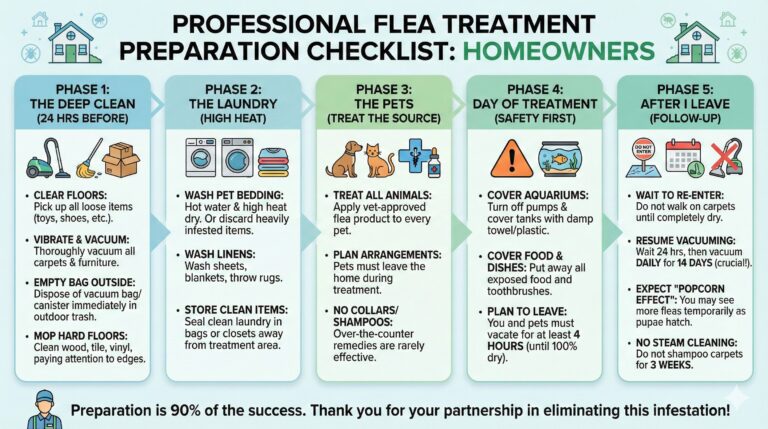
Flea treatments are a partnership. I bring the chemistry (the insect growth regulators and adulticides), but you bring the mechanical control (vacuuming and clearing). Without your prep work, the fleas will have plenty of places to hide, and the treatment won’t break their life cycle.
Here is the professional checklist I give to all my clients to ensure we knock this infestation out the first time.
Phase 1: The Deep Clean (Do this 24 hours before treatment)
This is the most critical step. We need to expose as much surface area as possible and mechanically remove flea eggs and pupae.
Clear the Floors:
- Pick up everything off the floors: toys, shoes, magazines, boxes, pet beds, and closet floor items.
- I need to spray the entire carpet surface and baseboards without obstruction.
- Note: Stack items on tables, beds, or sofas.
- Don’t forget closets: Remove shoes, boxes, and items from closet floors where pets might nap. Vacuum closet carpets.
The “Vibrate & Vacuum” Technique:
- Vacuum all carpets, rugs, and furniture thoroughly-including:
- Under furniture (move couches, chairs, beds if possible)
- Stairs and hallway runners
- Upholstered furniture (sofas, chairs, pet furniture)
- Vehicle interiors (if pets ride in your car regularly)
- Remove couch/chair cushions: Take all cushions off and vacuum the base of furniture and between/under cushions. If pets sleep on furniture, this is where flea eggs accumulate.
- Flip mattresses: If pets sleep in beds, flip mattresses to expose all sides.
- Why? The vibration forces flea pupae (cocoons) to hatch into adults, making them vulnerable to my spray. It also lifts carpet fibers so treatment penetrates deep.
- The Bag: Immediately empty the canister or throw away the vacuum bag in an outside trash can. Do not leave it inside!
Mop Hard Floors:
- Sweep and mop wood, tile, and vinyl floors.
- Pay attention to edges/baseboards where dust (and flea larvae) collect.
Strip the Beds:
- If pets sleep in your bed, strip all linens, blankets, and bedskirts.
Phase 1.5: Outdoor Areas (Often Overlooked)
If your pets spend time outdoors, the yard can be a flea reservoir that causes re-infestation.
Mow the Lawn:
- Cut grass short (2-3 inches) in areas where pets spend time.
- This exposes flea larvae to sunlight and makes treatment more effective.
Clear Yard Debris:
- Remove piles of leaves, wood, or tall weeds where fleas hide.
- Focus on shaded areas under decks, porches, or shrubs.
Treat Dog Houses/Outdoor Kennels:
- Wash or replace outdoor pet bedding.
- If the doghouse is heavily infested, I may need to treat it separately (or recommend you spray it with outdoor flea spray after I treat the interior).
Weather Watch:
- If I’m treating your yard and rain is forecasted within 24 hours, we may need to reschedule the outdoor portion so the product doesn’t wash away.
Phase 2: The Laundry
Heat is your friend here. Fleas cannot survive the dryer.
Wash Pet Bedding:
- This is ground zero. Wash all pet bedding in hot water and dry on high heat.
- If the bed is old and heavily infested, honestly? Throw it out and buy a new one after treatment.
Wash Family Linens:
- Wash all sheets, blankets, throw rugs, and pet blankets that have been exposed to pets.
Non-Washable Items:
- For pet toys, pillows, or bedding that can’t go in the washer:
- Freeze them: Seal in a plastic bag and freeze for 48 hours (kills all life stages).
- Discard them: If heavily infested, throw them away and replace post-treatment.
Store Clean Items:
- Put clean laundry in large plastic bags or a clean closet so they don’t get re-infested during prep.
Phase 3: The Pets
There’s 100s of products on the market. Consult with your vet for your pets.
Treat All Animals:
- Every dog and cat in the home must be treated with a veterinarian-approved flea control product (like a topical drop or oral chew).
- Warning: Flea collars and “natural” shampoos from the grocery store are rarely effective for active infestations.
Arrangements for Treatment Day:
- Pets cannot be home during the spraying.
- Plan to take them with you or board them for a few hours.
- If pets ride in your car: Vacuum the car seats, floor mats, and trunk thoroughly before putting pets inside. Consider a pet-safe flea spray for auto interiors if the infestation is severe.
Phase 4: Day of Treatment (Safety First)
On the day I arrive, the house needs to be ready for chemical application.
Timing Recommendation:
- Schedule treatments for morning if possible, so the product has maximum drying time during daylight. This allows you to return home by evening.
Cover Aquariums:
- If you have fish or reptiles, turn off the air pump/filter and cover the tank completely with a damp towel or plastic wrap.
- Fish are very sensitive to insecticides.
Cover Food:
- Put away all exposed food, dishes, and toothbrushes.
Plan to Leave:
- You and your pets must vacate the home during treatment and stay out until the product is 100% dry.
- Standard Rule: Plan to be out for at least 4 hours.
Phase 5: After I Leave (The Follow-Up)
This is where people often get confused. Please read this carefully!
The Drying Period:
- Do not re-enter until the floors are dry to the touch.
- If you enter too soon, you might slip, and you’ll pull the product off the carpet onto your shoes.
The “Popcorn” Effect:
- You might see more fleas for a few days after treatment. Don’t panic.
- These are pupae hatching (triggered by your movement). They will jump onto the treated carpet and die shortly after contact.
- This is normal and means the treatment is working.
Resume Vacuuming:
- Wait 24 hours after treatment, then vacuum every day for 14 days.
- Crucial: This vibration encourages remaining stubborn pupae to hatch so they hit the treated carpet and die. It speeds up elimination.
- Immediately throw away vacuum bags/empty canisters into outside trash after each use.
Do Not Carpet Clean:
- Do not steam clean or shampoo carpets for at least 3 weeks. This washes away the residual product.
Second Treatment Window:
- Flea pupae can remain dormant for weeks. If you’re still seeing fleas 21 days after treatment, contact me.
- A second treatment may be necessary to catch late-emerging adults.
- This is normal for severe infestations and not a treatment failure.
Ongoing Prevention (The “Never Again” Step):
- Even after the infestation is gone, keep all pets on veterinarian-approved flea prevention year-round.
- This is the only way to prevent re-infestation.
- Worcester County tip: Fleas can survive mild New England winters indoors. Don’t skip winter prevention.
Landlord Checklist
Massachusetts Landlord Responsibilities & Tenant Coordination
As a landlord in Massachusetts, you have specific legal obligations regarding pest control under MA State Sanitary Code 105 CMR 410.550. Here’s how to handle a flea infestation properly while protecting yourself legally and maintaining good tenant relations.
Step 1: Determine Responsibility (Who Pays?)
Massachusetts Law:
- Landlords are responsible for providing pest-free housing at the start of tenancy.
- If fleas are present at move-in OR caused by building conditions (infested common areas, previous tenant’s pets): Landlord pays.
- If fleas are introduced by current tenant’s pets: Tenant may be responsible for treatment costs.
Gray Area – Burden of Proof:
- If both parties have pets or there’s no clear documentation, it often falls on the landlord to treat the unit to maintain habitability.
- Practical tip: Even if tenant caused it, paying for treatment now prevents escalation (rent withholding, board of health complaints, lease breaks).
Document Everything:
- Take photos of the infestation (flea dirt on carpets, live fleas, bites on tenant).
- Document when the issue was reported and your response timeline.
- Keep receipts for all treatments and related costs.
Step 2: Legal Notice to Tenant
You must provide written notice before treatment.
Step 3: Coordinate Treatment in Multi-Unit Buildings
If You Own a Triple-Decker or Multi-Family:
Fleas can migrate between units through shared walls, ventilation, or stairwells-especially common in Worcester’s historic triple-deckers.
Building-Wide Assessment:
- Inspect adjacent units (above, below, and next door).
- If fleas are found in multiple units, treat all infested units on the same day to prevent migration.
Shared Common Areas:
- Treat hallways, basements, and laundry rooms if tenants’ pets use these spaces.
- Vacuum shared carpets/rugs before treatment.
Tenant Communication:
- Notify all tenants in the building about the treatment schedule, even if their units aren’t being treated.
- Example: “We are treating Unit 2 for fleas on [date]. As a precaution, please keep your pets on flea prevention and vacuum your unit thoroughly.” See the below tenant letter you can copy/paste
Cost Allocation (Multi-Unit):
- If one tenant caused the infestation, you may charge them for their unit only.
- If it’s unclear or building-wide, landlord typically pays to avoid tenant disputes.
Step 4: What If Tenant Refuses to Prepare or Vacate?
Legal Options:
- If tenant refuses to prepare, document the refusal in writing.
- Send a second notice stating that failure to comply may result in:
- Treatment cancellation and rescheduling at tenant’s expense.
- Lease violation (if lease includes pest cooperation clause).
- If tenant repeatedly refuses and infestation worsens, consult an attorney about lease termination for breach.
Practical Advice:
- Offer to help elderly or disabled tenants with prep (or hire a cleaner as a goodwill gesture).
- For uncooperative tenants, treat anyway if possible and document that you fulfilled your legal duty-even if tenant sabotaged effectiveness.
Step 5: Post-Treatment Follow-Up
Inspection Timeline:
- Schedule a follow-up inspection 21 days after treatment to assess results.
- If fleas persist, a second treatment is often necessary (pupae can take 2-3 weeks to hatch).
Prevent Blame Disputes:
- Document that you provided treatment, tenant checklist, and follow-up.
- If re-infestation occurs due to tenant’s failure to treat pets, you have grounds to charge for future treatments.
Ongoing Prevention Clause (Add to Lease):
- “Tenant agrees to maintain all pets on veterinarian-approved flea prevention year-round. Tenant is responsible for treatment costs if fleas re-infest the unit due to failure to maintain pet preventatives.”
Step 6: Board of Health Complaints
If Tenant Reports You:
- Massachusetts tenants can report landlords to the local Board of Health for pest issues.
- Your defense: Documented timeline showing you addressed the issue promptly and professionally.
What Inspectors Want to See:
- Written notice to tenant (with prep checklist).
- Proof of professional treatment (invoice from PESTalytix).
- Follow-up inspection scheduled.
Landlord FAQ
Q: Can tenant withhold rent for fleas?
A: Yes, under MA law, severe pest infestations can violate the “implied warranty of habitability.” Tenants may withhold rent or pay for treatment and deduct from rent. Avoid this by responding quickly.
Q: Can tenant break the lease due to fleas?
A: Yes, if the infestation is severe and you fail to address it promptly, tenant may have grounds to break the lease without penalty.
Q: Do I have to pay if the tenant’s pet caused the fleas?
A: Legally, you can charge the tenant if their pets caused the issue and your lease includes a pest responsibility clause. However, paying upfront and deducting from security deposit is often smoother than fighting during tenancy.
Q: What if I find fleas after the tenant moves out?
A: Document with photos, deduct treatment cost from security deposit, and send itemized deduction statement within 30 days (MA law).
Property Manager Checklist
For Portfolio-Scale Flea Treatment & Prevention
As a property manager overseeing multiple units or buildings, you need systems that prevent flea outbreaks from spiraling into tenant complaints, code violations, and emergency costs.
Pre-Infestation: Prevention Protocols
Lease Language (Standard Across Portfolio):
- Add this clause to all leases: “Tenant agrees to maintain all pets on veterinarian-approved flea prevention year-round. Tenant must notify Property Manager within 24 hours of observing fleas. Tenant is responsible for treatment costs if fleas result from failure to maintain pet preventatives.”
Pet Policy Documentation:
- Require proof of flea prevention at lease signing (copy of vet receipt or medication package).
- Include flea prevention requirement in pet addendum.
Move-In Inspections:
- Document that units are pest-free before tenancy begins.
- Take photos of carpets, baseboards, and flooring.
- If previous tenant had pets, consider preventative treatment between tenancies (especially in heavily infested cases).
Preventative Maintenance:
- Vacuum and steam-clean carpets between tenancies (heat kills flea eggs/larvae).
- Treat shared common areas (hallways, laundry rooms, basements) quarterly if pets are allowed in the building.
Active Infestation: Incident Response Protocol
Step 1: Initial Report
- Log the complaint immediately (date, unit, tenant name, description).
- Send tenant the Homeowner Checklist (above) via email within 24 hours.
- Schedule inspection within 48-72 hours to assess severity.
Step 2: Severity Assessment
- Low: Tenant reports seeing 1-2 fleas, no bites, no evidence of reproduction.
- Action: Provide tenant with DIY guidance (vacuum daily, treat pets, monitor for 7 days).
- Schedule professional treatment if fleas persist.
- Moderate: Multiple fleas observed, bites reported, flea dirt visible on carpets.
- Action: Schedule professional treatment within 5 business days.
- Severe: Heavy infestation, tenant unable to sleep, children/elderly affected, multiple units involved.
- Action: Emergency treatment within 24-48 hours. Consider temporary relocation if unit is uninhabitable.
Step 3: Multi-Unit Coordination
- If fleas are reported in one unit of a multi-family building:
- Inspect adjacent units (above, below, next door).
- Notify all tenants in the building about the treatment schedule.
- Treat all infested units on the same day to prevent migration.
- Worcester County-specific: Triple-deckers and balloon-frame buildings (common in Worcester) allow flea migration through shared wall voids. Don’t assume isolated unit.
Step 4: Treatment Scheduling
- Provide tenant with 7 days’ notice (unless emergency).
- Use the Notice to Tenant template
- Confirm tenant availability and prep compliance 48 hours before treatment.
Step 5: Documentation
- Create a flea treatment file for each incident containing:
- Tenant complaint (date, description)
- Inspection photos
- Notice to tenant (signed acknowledgment)
- Treatment invoice from PESTalytix
- Follow-up inspection notes (21 days post-treatment)
Vendor Management (Working with PESTalytix)
Portfolio-Level Agreement:
- Negotiate a preferred rate for multi-unit treatments (cost per unit decreases when treating entire buildings).
- Establish priority response times for your properties (e.g., 48-hour response for emergencies).
Service Documentation:
- Request digital service reports from PESTalytix after each treatment (date, units treated, products used, follow-up recommendations).
- Use reports to update property files and respond to owner inquiries.
Preventative Contract:
- For buildings with chronic flea issues (high pet population, older construction), consider quarterly preventative treatments of common areas.
- ROI: Prevents emergency call-outs and tenant complaints, which cost more than scheduled prevention.
Tenant Cooperation Enforcement
If Tenant Fails to Prepare:
- Document the failure (photos of cluttered floors, unprepared unit).
- Reschedule treatment and send written notice that rescheduling fees will be charged to tenant.
- If tenant repeatedly refuses to cooperate:
- Consult legal counsel about lease violation proceedings.
- Document that you fulfilled duty to provide treatment-tenant sabotaged effectiveness.
If Tenant Refuses to Treat Pets:
- Send certified letter stating: “Per your lease agreement, all pets must be on veterinarian-approved flea prevention. Failure to treat pets will result in re-infestation, for which you will be financially responsible. Professional treatment is scheduled for [date]. If fleas return due to untreated pets, future treatments will be billed to you.”
Cost Recovery & Budgeting
Who Pays?
| Scenario | Responsible Party |
|---|---|
| Fleas present at move-in (previous tenant’s pets) | Owner/Property Manager |
| Fleas caused by building conditions (infested common areas) | Owner/Property Manager |
| Fleas introduced by current tenant’s pets (documented) | Tenant (deduct from security deposit or bill directly) |
| Unclear origin (no documentation, both sides have pets) | Owner/Property Manager (avoid disputes) |
Billing Tenants:
- If tenant is responsible, provide itemized invoice showing:
- Treatment cost per unit
- Rescheduling fees (if applicable)
- Lost rent (if unit was uninhabitable due to tenant’s failure to act)
- Deduct from security deposit or bill tenant directly with 30-day payment terms.
Budgeting for Owners:
- Include line item in annual budget: “Pest Control – Reactive Treatments” (estimate $150-300 per unit per year for buildings with pets).
- For chronic flea buildings, recommend owners budget for quarterly preventative treatments ($75-100 per unit quarterly = cheaper than emergency call-outs).
Compliance & Liability
Massachusetts Sanitary Code 105 CMR 410.550:
- Landlords/property managers must maintain pest-free housing.
- Failure to address infestations promptly can result in:
- Board of Health citations
- Tenant rent withholding
- Lease termination (tenant-initiated)
- Legal liability for health issues (allergic reactions, secondary infections from bites)
Documentation Best Practices:
- Maintain digital files for all flea incidents (complaints, photos, treatment records, follow-ups).
- Respond to tenant complaints in writing within 24 hours (even if just acknowledging receipt).
- Schedule treatments within 5 business days of confirmed infestation (emergencies within 24-48 hours).
Liability Protection:
- If tenant is bitten or develops health issues, document your timely response to the complaint.
- Never ignore or delay-this creates legal exposure.
Portfolio-Wide Trends & Prevention
Track Infestation Patterns:
- Which buildings/units have repeat flea issues?
- Are infestations seasonal (spring/summer spikes)?
- Are certain tenant demographics (multiple pets, poor housekeeping) correlated with infestations?
Building Upgrades:
- For older properties (pre-1950 construction common in Worcester), consider:
- Replacing carpets with hard flooring (tile, laminate) in units where pets are allowed. Fleas can’t hide/reproduce on hard surfaces.
- Common area treatments: Quarterly preventative treatments of hallways, basements, laundry rooms.
Tenant Education:
- Provide new tenants with pets a “Pet Care & Pest Prevention” handout at lease signing, including:
- Requirement for year-round flea prevention
- Contact info for local veterinarians
- Notice that flea treatment costs will be tenant’s responsibility if caused by untreated pets
Property Manager FAQ
Q: How much does flea treatment cost per unit?
A: Typical range: $150-300 per unit for professional treatment (varies by unit size, carpet vs. hard floors, severity). Multi-unit discounts available contact PESTalytix for portfolio pricing.
Q: How long does treatment take?
A: 30-60 minutes per unit (depending on size). Tenants must vacate for 4 hours minimum.
Q: Will one treatment eliminate the infestation?
A: Usually, yes if tenant prepares properly and continues daily vacuuming for 14 days. Severe infestations may require a second treatment 21 days later (to catch late-emerging pupae). This is normal, not a treatment failure.
Q: Can we treat just one unit in a triple-decker?
A: Not recommended if units share wall cavities (balloon-frame construction). Fleas migrate through shared voids. Inspect and treat adjacent units on the same day to prevent re-infestation.
Q: What if tenant damages carpets trying to DIY treat before calling us?
A: Document damage with photos. If tenant used unauthorized chemicals (gasoline, bleach, etc.) that damaged property, deduct repair costs from security deposit. Always direct tenants to call you first before attempting DIY treatments.
Q: Should we require flea prevention proof at annual lease renewal?
A: Yes, if the building has a history of infestations. Request updated vet records showing pets are current on flea prevention. This creates accountability and reduces call-outs.
Emergency Protocol (Severe Infestations)
When to Escalate:
- Tenant reports inability to sleep due to bites.
- Children, elderly, or immunocompromised residents affected.
- Fleas observed in multiple units simultaneously.
- Tenant threatens to contact Board of Health, withhold rent, or break lease.
Immediate Actions:
- Call PESTalytix for emergency same-day or next-day service: [Your Phone Number]
- Offer tenant temporary relocation (hotel, vacant unit) if infestation makes unit uninhabitable.
- Document everything: photos, tenant communications, treatment timeline.
- Send certified letter to tenant confirming your response and next steps.
Post-Emergency:
- Schedule follow-up inspection 7 days and 21 days after treatment.
- If infestation was tenant-caused (untreated pets), bill tenant for emergency treatment costs + temporary relocation costs (if applicable).
Recommended Tools for Property Managers
Digital Tracking:
- Use property management software (Buildium, AppFolio, Rent Manager) to log pest complaints and track treatment history.
- Tag units with “Flea History” flag for future reference.
Vendor Communication:
- Provide PESTalytix with:
- Master list of your portfolio properties (addresses, unit counts)
- Emergency contact numbers (property manager, maintenance supervisor)
- Preferred scheduling method (phone, email, portal)
Owner Reporting:
- Include pest treatment costs in monthly owner statements with notation: “Flea Treatment – Unit 2B – Tenant Responsible (Deducted from Security Deposit)” or “Owner Responsible (Building Condition).”
Final Note for Property Managers:
Flea infestations are 100% preventable with proper tenant education and pet policy enforcement. The properties that never call me for flea emergencies are the ones that:
- Require proof of flea prevention at lease signing
- Inspect units quarterly
- Treat common areas preventatively
- Respond to reports within 48 hours
The properties that call me every summer? They wait until tenants complain, then scramble to react. Which would you rather be?
Letter to Tenants for Landlords and Property Managers
Here is a professional, clear, and firm notice you can use. I’ve written this to emphasize that their cooperation is safer for them and ensures they won’t have to deal with us coming back for a re-treatment.
You can copy and paste this directly into a document or email.
NOTICE OF MANDATORY PEST CONTROL TREATMENT: FLEAS
Date: [Insert Date]
To: Residents of [Insert Unit Number/Address]
From: Management / Landlord
Scheduled Treatment Date: [Insert Date]
Arrival Time Window: [Insert Time, e.g., Between 9:00 AM and 12:00 PM]
To ensure a comfortable and pest-free living environment, we have scheduled a professional flea treatment for your unit.
Crucial Information:
Flea treatments require a partnership between the resident and the technician. The treatment cannot be performed if the unit is not prepared according to the checklist below. If the unit is not prepped, the fleas will likely survive, and the treatment will have to be repeated.
Required Preparation Checklist (Complete by [Time] on [Date])
1. Clear the Floors
- Remove all loose items from floors (shoes, toys, boxes, magazines, etc.) and place them on tables or beds.
- The technician needs access to spray all carpeted areas and baseboards.
- Closet floors must be cleared.
2. Deep Vacuum & Clean
- Thoroughly vacuum all carpets, rugs, and upholstered furniture. This is the most important step.
- Immediately dispose of the vacuum bag or empty the canister in an outside trash bin.
- Sweep and mop all hard surface floors (wood/tile/vinyl).
3. Laundry
- Strip all bed linens and wash them in hot water.
- Pet Bedding: Wash all pet bedding on high heat or discard it.
- Cover fish tanks with a damp towel and turn off air pumps (fish are sensitive to the treatment).
- Put away all exposed food, dishes, and toothbrushes.
4. Pets
- All pets must be removed from the unit during the treatment.
- All pets should be treated with a vet-approved flea control product (drops or oral medication) on the same day to prevent them from bringing fleas back inside.
During & After Treatment
- Vacating: Residents and pets must leave the unit during the service and remain out for at least 4 hours (or until the product is completely dry).
- Re-Entry: Do not walk on carpets until they are dry to the touch.
- Follow-Up: Resume vacuuming every day for the next 14 days. This forces hatching fleas to contact the treated surface. Do not steam clean carpets for 3 weeks.
Thank you for your cooperation in helping us resolve this issue quickly and effectively.
Best Regards,
Management / Landlord