

The Challenge of Continuous Data
Digital monitoring devices generate constant activity streams, but converting that data into consistent service decisions remains one of our industry’s hardest operational challenges. When does activity at a single station warrant a truck roll? How do you make those calls defensible to demanding customers in food plants or distribution centers? How do you maintain consistency across hundreds of stations without drowning technicians in false alarms?
Traditional approaches rely on visual inspection or fixed activity thresholds, but these methods struggle with the inherent variability in monitoring data. A station near a loading dock behaves completely differently than one in a production floor break room. Seasonal patterns, facility operations, and environmental conditions create natural variation that generic thresholds cannot handle.
This article explains a station-specific, signal-based methodology designed to address these operational realities. The approach evaluates five independent detection signals, each catching different manifestations of rodent pressure while remaining robust to the noise and outliers we all deal with in real-world setups.
The Core Principle: Station-Specific Baselines
The fundamental insight is simple: there is no universal definition of “normal” rodent activity. Every station has its own behavioral fingerprint based on placement, facility operations, environmental factors, and local conditions.
Rather than applying industry-standard thresholds, this methodology establishes rolling historical baselines for each station individually. A station is compared to its own recent behavior, not to arbitrary standards or to other stations.
This approach requires sufficient historical data per station (a minimum learning period for new installations) but eliminates the need for manual threshold tuning across diverse site conditions. The system adapts to each location’s characteristics automatically.
Signal 1: Extreme Activity Detection
This signal catches days when activity jumps far outside a station’s established range.
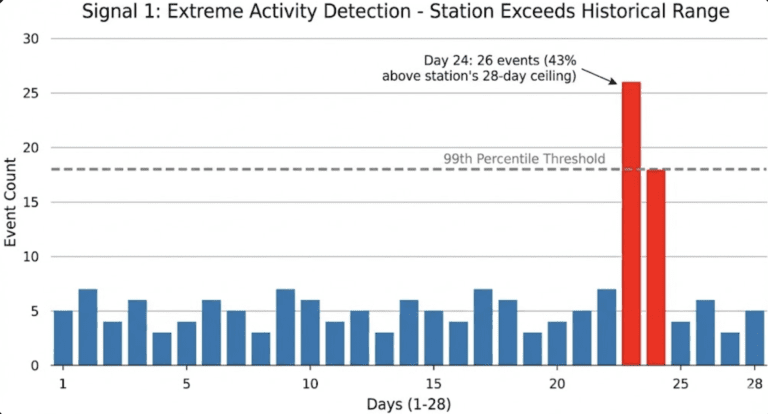
The system tracks each station’s activity distribution over recent history and identifies the upper boundary of observed variation. When current activity exceeds this statistical ceiling, the extreme activity signal fires.
Key design choices:
- Uses upper percentile bounds rather than standard deviation (more resistant to outliers)
- Requires minimum event density to prevent single isolated events from triggering
- Recalculates thresholds continuously using rolling windows (adapts to changing conditions)
This signal responds quickly to sudden onset problems like new entry points, facility modifications, or food source changes that immediately increase pressure.
Signal 2: Robust Baseline Deviation
This signal detects statistically abnormal behavior using methods specifically designed to resist distortion from outliers.
Most anomaly detection approaches use mean and standard deviation. The problem? A single outlier day can inflate standard deviation so much that nothing looks unusual anymore. We’ve all seen this – a sensor malfunction or one-time event corrupts your baseline, and suddenly real problems don’t register as abnormal.
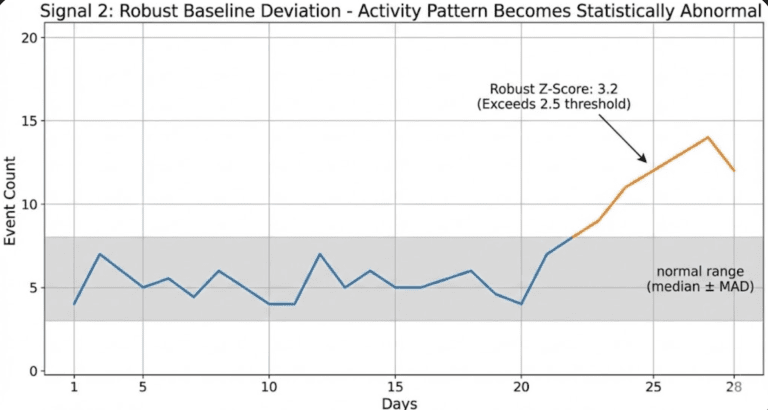
This methodology uses Median Absolute Deviation (MAD) instead. MAD calculates variation using medians at every step, so outliers have minimal impact on baseline estimates. A station can have several anomalous days in its history without those days distorting the definition of “normal.”
The system calculates a robust z-score that behaves like a traditional z-score but remains stable even with messy data. Thresholds are differentiated by placement – interior stations use tighter sensitivity than exterior stations, reflecting different risk tolerance levels.
This signal catches pattern changes that might not appear as dramatic spikes: gradual increases, sustained moderate elevation, or shifts in activity characteristics that indicate developing pressure.
Signal 3: Sustained Escalation
This signal distinguishes between random fluctuation and genuine trending pressure.
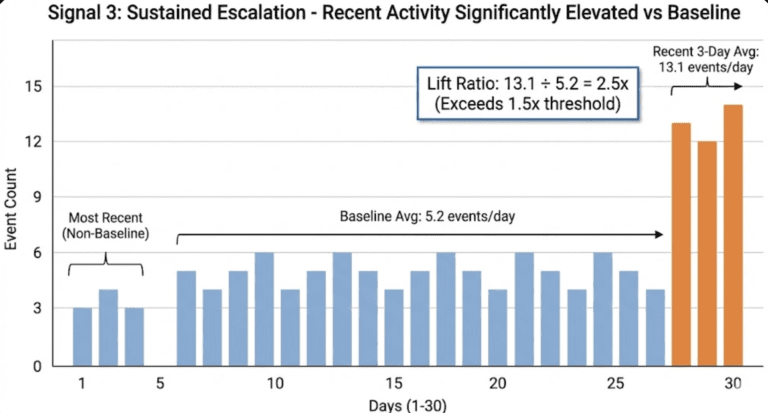
A one-day spike might be noise. When recent days consistently average higher than the longer-term baseline, that’s a trend. Trends indicate building populations or establishment behavior that won’t resolve without treatment.
The system compares short-term recent activity against a longer baseline period, looking for sustained lift ratios that exceed placement-specific thresholds. Interior locations trigger on lower lift levels than exterior locations, and minimum recent activity requirements prevent mathematical artifacts from low baseline counts.
Critical setup detail: The baseline window excludes the most recent days. This prevents today’s emerging problem from immediately becoming part of the definition of “normal.” The baseline represents established patterns, not current developments.
This signal provides early warning on building pressure while counts remain manageable, before problems become acute enough to generate customer complaints.
Signal 4: Behavioral Acceleration
This signal tracks inter-arrival time – how quickly rodents return to the same station.
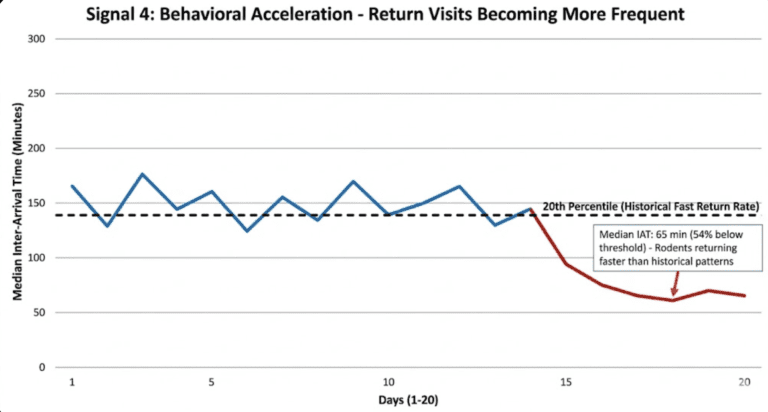
Rodent populations often show accelerating return behavior before activity counts spike dramatically. A station that used to see visits hours apart but now sees them under an hour apart indicates establishment, population growth, or increasing food pressure.
For each day with multiple events, the system calculates median time between events and compares it to historical patterns. When current inter-arrival time drops below historical lower percentiles, the acceleration signal fires.
Why this matters operationally: You can detect problems while total event counts remain moderate. A station going from 4 events/day to 8 events/day might not trigger count-based signals yet, but if those 8 events are clustered into a 2-hour window instead of spread across the night, behavioral acceleration catches the pattern change.
Interior and exterior stations use different percentile thresholds, reflecting different expectations for normal visiting frequency in different environments.
Signal 5: Confirmed Physical Events
This signal responds to verified captures, kills, or other definitive evidence events.
When monitoring devices record confirmed physical events (depending on device capabilities and data feed quality), this signal triggers immediate action regardless of statistical context. Physical evidence eliminates uncertainty – statistical analysis becomes irrelevant.
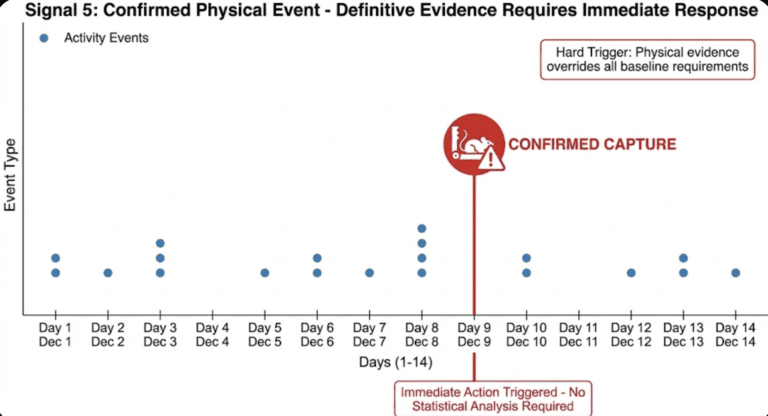
Unlike the other four signals, confirmed events trigger action even on brand new stations without established baselines. You don’t need historical context when you have a dead rodent.
Implementation reality: This signal’s effectiveness depends entirely on upstream data feeds providing reliable event classification. In setups where event types are ambiguous or inconsistently tagged, this trigger may need to remain inactive until data quality improves.
How the Signals Work Together
These five signals operate independently and evaluate the same station-day data. Action is recommended when any single signal fires – you don’t need all five, or even multiple signals, to generate a recommendation.
This multi-signal architecture provides several operational advantages:
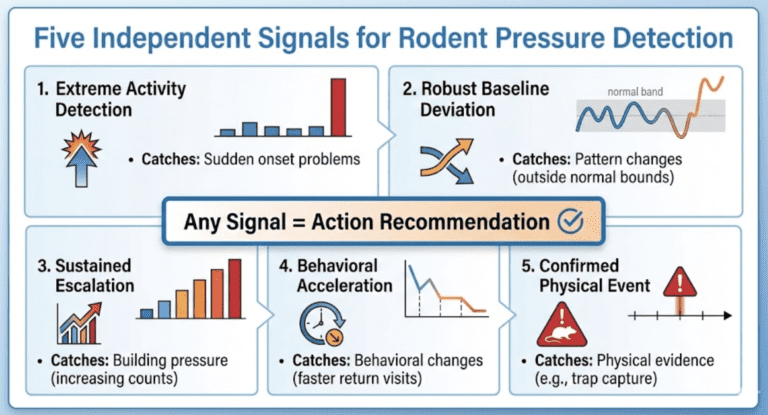
Temporal coverage: Fast-onset problems trigger extreme activity or confirmed events. Slow-building pressure triggers escalation. Behavioral changes trigger acceleration before counts become severe. You catch problems at different stages of development.
Pattern diversity: Rodent pressure manifests differently across facilities, seasons, and situations. Multiple independent signals adapt to this diversity without requiring manual configuration for each site type.
Failure redundancy: If one signal misses a problem due to local data characteristics, others may catch it through different detection mechanisms. This reduces missed detections without increasing false positives.
Explainability: Every recommendation can be traced to a specific signal with clear triggering conditions. “Station MS-142 exceeded its 28-day activity ceiling” is more defensible to a food plant QA manager than “the algorithm flagged this location.”
Placement-Specific Sensitivity
Interior and exterior stations don’t just use different threshold values – they use different tolerance levels across multiple signals and different composite scoring requirements.
This differentiation reflects fundamental differences in risk tolerance and expected behavior:
Interior stations use tighter sensitivity on deviation signals, lower lift requirements for escalation, faster response to behavioral changes, and lower composite score thresholds. Any sustained activity indoors warrants closer scrutiny.
Exterior stations accommodate natural environmental variation, require stronger statistical evidence before triggering, and focus on preventing inward migration rather than eliminating all background activity.
Critical operational requirement: This only works if you have reliable placement metadata. When placement type is unknown or inconsistent, the system suppresses recommendations rather than applying incorrect sensitivity. Better to flag a data quality issue than make bad service calls.
Baseline Readiness and Learning Periods
Four of the five signals depend on station-specific baselines, and those baselines require sufficient historical data to be meaningful.
New station setups go through a learning period where the system accumulates enough history to establish reliable baseline statistics. During this period (typically requiring a minimum number of days with data), only confirmed physical events can trigger recommendations. Baseline-dependent signals remain inactive.
This prevents spurious recommendations on insufficient data. A station with 3 days of history shouldn’t generate statistical anomaly alerts – you don’t know what “normal” is yet.
The system transparently communicates this status (both internally and to customers when needed), showing current baseline day counts and readiness state. This sets appropriate expectations during installation rollouts.
Rolling windows: Baselines use rolling historical windows that adapt continuously to changing conditions. Seasonal variation, operational changes, and facility modifications naturally incorporate over time without requiring manual recalibration. The windows exclude the most recent data to keep baselines representative of established patterns rather than emerging problems.
Composite Risk Scoring
Beyond binary go/no-go triggers, the system calculates a composite risk score combining all signals into a single prioritization metric.
This score serves critical operational purposes:
- Prioritizing which stations need attention most urgently when multiple locations trigger
- Routing decisions when technician capacity is constrained
- Identifying locations trending toward thresholds before they cross
- Supporting proactive scheduling decisions
The composite score uses weighted components from all five signals, with appropriate null-handling to prevent score corruption when data is sparse or metrics are unavailable. Placement-specific score thresholds determine when composite risk alone warrants action, even if no individual signal has fired.
Operational use case: Two stations both triggered signals yesterday. Today, one has a composite score of 6.2 and the other 8.7. The 8.7 location gets prioritized for same-day response while the 6.2 location goes on tomorrow’s route. Both need attention, but composite scoring enables intelligent resource allocation.
Implementation Considerations for the Industry
Why not machine learning? This methodology deliberately uses statistical calculations rather than ML models. Every recommendation is explainable through transparent threshold comparisons and metric calculations. When you’re explaining a service call to a plant manager or defending a finding in a third-party audit, “the neural network scored this as high risk” doesn’t cut it. “Activity exceeded this station’s 28-day statistical ceiling by X events” does.
Scalability: The approach scales well in modern data platforms because it relies on windowed aggregations and conditional logic rather than iterative algorithms. We’re running this across thousands of station-days daily in BigQuery without performance issues.
Configuration flexibility: The thresholds and weights we’re using represent validated defaults from operational setup, but any serious setup should externalize these parameters. Different customer segments (food production vs. general commercial) might warrant different sensitivity calibrations. Regional patterns or regulatory constraints might require adjustments.
Data quality requirements: This methodology is forgiving of sparse data and noise (that’s why we use robust statistics), but it still requires:
- Accurate event timestamps with consistent time zones
- Reliable daily event counts (with appropriate null-handling)
- Clean inter-arrival calculations (filtering sensor issues and DST artifacts)
- Current, accurate device metadata (especially placement type)
Garbage in, garbage out still applies – but the robust statistics make this much more resilient than traditional approaches.
False positive management: The multi-layered approach (minimum event guards, baseline gating, robust statistics, placement awareness) is intentionally conservative. The system waits for strong evidence rather than over-triggering. In our operational setup, we’re not seeing the “technician shows up to find nothing” problem that plagued earlier monitoring setups.
Conclusion
Digital monitoring generates valuable data streams, but converting those streams into consistent operational decisions requires structured methodology. Calendar-based scheduling ignores the data. Simple thresholds oversimplify the variability. This five-signal approach provides a framework that balances sensitivity with specificity, adapts to local conditions, and maintains decision transparency.
Each signal addresses a different aspect of rodent pressure development. Together, they provide coverage from rapid onset to slow build, handle diverse facility conditions, and remain robust to real-world data quality issues.
The methodology is working in production setup today, processing thousands of station-days and generating service recommendations that have proven reliable in the field.
FAQs
How is this different from setting a fixed activity threshold across all stations?
Fixed thresholds (like “service when you see 10+ events”) treat every station identically and ignore local context. A loading dock station seeing 10 events might be completely normal, while an interior break room seeing 10 events indicates serious pressure. The five-signal approach establishes station-specific baselines, so each location is compared to its own historical behavior rather than an arbitrary industry standard. This eliminates the false alarms from naturally active exterior stations while maintaining high sensitivity in critical interior locations.
What happens when you install a new monitoring station without any historical data?
New stations go through a learning period where the system accumulates enough history to establish reliable baseline statistics. During this period (typically requiring a minimum number of days with activity data), only confirmed physical events trigger action recommendations. The other four signals remain inactive until sufficient baseline data exists. The system transparently communicates this “building baseline” status rather than making unreliable recommendations on insufficient data. This prevents spurious service calls during installation rollouts while setting appropriate expectations.
Does this work with any brand of digital monitoring device?
The methodology is device-agnostic-it analyzes the activity data itself, not specific hardware features. As long as your monitoring devices provide timestamped event data with consistent device identifiers, the five-signal approach can process it. The main requirement is data feed quality: accurate timestamps, reliable event counts, and current device metadata (especially placement type). The effectiveness of the “confirmed physical event” signal depends on whether your devices provide tagged capture/kill events, but the other four signals work with basic activity streams.
How do you prevent false positives from sensor malfunctions or one-time anomalies?
The methodology uses multiple layers of false positive protection. First, it employs robust statistics (Median Absolute Deviation instead of standard deviation) that naturally resist distortion from outliers. Second, it requires minimum event density before certain signals can fire a single isolated event won’t trigger action. Third, baseline windows are designed to exclude the most recent data, preventing today’s anomaly from immediately becoming part of “normal.” Fourth, signals require sustained patterns or extreme deviations, not just any increase. These safeguards work together so you get reliable recommendations instead of chasing sensor glitches.
Can you adjust the sensitivity for different customer types or facility risk levels?
Yes, though the standard setup already includes placement-based differentiation (interior vs. exterior). For operations serving different market segments-say, food production facilities versus general commercial accounts-the threshold parameters and weighting schemes can be externalized into configuration. This allows calibration based on customer requirements, regulatory environments, or contractual obligations without changing core logic. The key is maintaining transparency and documentation of any customer-specific adjustments for audit purposes.
How do you explain these recommendations to customers who want to know why you’re servicing?
Every recommendation is traceable to a specific triggering signal with concrete metrics. Instead of “our system flagged this location,” you can explain “Station MS-142’s activity exceeded its 28-day statistical ceiling by 18 events” or “Recent 3-day average is running 2.1x higher than the baseline period.” The methodology provides customer-facing reason labels and supporting context for each recommendation. This transparency supports difficult conversations with plant managers or QA directors who want data-backed justification for service calls, especially in regulated environments.
What data quality issues will break this approach?
The methodology is resilient to sparse data and noise (that’s the point of robust statistics), but it still requires foundational data hygiene: accurate event timestamps with consistent time zones, reliable device-to-location mapping, and current placement metadata. The most common failure mode is unknown or inconsistent placement type-when the system doesn’t know if a station is interior or exterior, it suppresses recommendations rather than applying incorrect sensitivity. Missing metadata is treated as a data quality problem requiring correction, not a signal interpretation issue. Sensor downtime or connectivity gaps are handled gracefully because the system works with available data, but prolonged outages obviously prevent detection.